|
924Board.org
Discussion Forum of 924.org
|
| View previous topic :: View next topic |
| Author |
Message |
Smoothie

Joined: 01 Jan 2003
Posts: 8032
Location: DE (the one near MD, PA, NJ)
|
 Posted: Sun Nov 18, 2007 5:53 am Post subject: home honing, plateau-ing and valve grinding ot: somewhat Posted: Sun Nov 18, 2007 5:53 am Post subject: home honing, plateau-ing and valve grinding ot: somewhat |
 |
|
The word "plateau" has only been used once in all the thousands of posts here, so this'll only be the second time...
-Slightly off topic because it's about work being done on a Jeep-AMC engine, but the info is universal to internal combustion engines (and any type of cylinder honing for that matter).
After ridge-reaming and honing the cylinders, something I end up doing with one of my engines about once every 10 years, I did some research on the web. First thing I find is that I've probably done waaay more honing than is usually called-for (but luckily I'm still within specs), and the other main thing I stumbled on is something new to me called "plateau" honing. Apparently a simple hone/cross-hatch patterning leaves sharp peaks and valleys - those peaks are cut down during break-in. This causes excessive initial wear of the rings and cylinders, and those tiny shards of metal get distributed around the engine, but mostly remain at the ring-to-cylinder wall interface to continue wear there on both rings and cylinders.
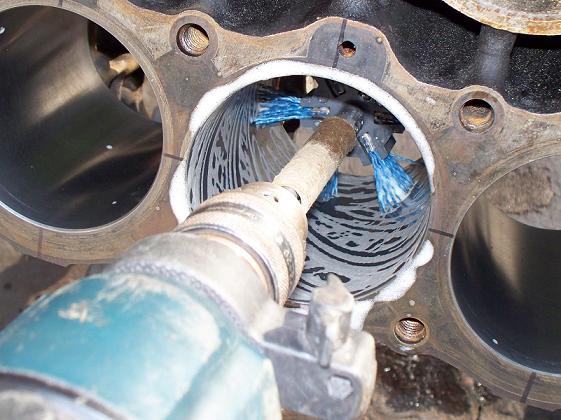
Plateau honing removes the peaks ahead of time, and they get flushed out and cleaned off of the cylinders before engine re-assembly. -So what you're left with are plateaus for the rings to glide on, and the valleys are still there to hold oil. In effect, part of the break-in process is taken care of before the engine is started. Engine builders and re-builders have a few ways of accomplishing this - some do the old fashioned stone-hone (but with a large dedicated machine rather than a hand-held drill) followed by brushing either with an abrasive-nylon brush or ball-end flex hone, some with more advanced equipment do a coarse diamond stone hone followed by a light pressure hone with a very fine diamond hone to accomplish the plateau-ing. -And there's another new process that uses lasers. -But all I have is the old (approx. 30 year old) Sears Craftsman 3-stone flexible hone for use with a hand drill (that was the cue for any real engine builders to cringe  )- until yesterday, that was all I had to do engine cylinder honing. Then I went down to the local hardware store where I'd seen a selection of those abrasive nylon brush drill attachments - got there and couldn't find any. Long story short, I looked some more later and found one on the floor in a corner under some other stuff - it was the correct type and roughly the right size, but without packaging, no price and covered with dust - took it to the owner to get a price - he said "looks used, just take it". )- until yesterday, that was all I had to do engine cylinder honing. Then I went down to the local hardware store where I'd seen a selection of those abrasive nylon brush drill attachments - got there and couldn't find any. Long story short, I looked some more later and found one on the floor in a corner under some other stuff - it was the correct type and roughly the right size, but without packaging, no price and covered with dust - took it to the owner to get a price - he said "looks used, just take it".  I obliged - took it home and held it over a cylinder and found it couldn't have been a more perfect size. I chucked it to the variable speed 1/2" drill (Bosch of course) with an extension. Sprayed a cylinder with soapy water and went to it - same up-down motion as the initial honing to follow the same cross-hatch pattern. It worked great. Of course I don't have any of the surface roughness measuring equipment that the "big fellas" use, but the affect was obvious - by sight, feeling and sound as the cylinder is wiped with a cloth, the result is a much smoother cylinder wall and the previously cross-hatch patterned valleys are still there to hold oil. I obliged - took it home and held it over a cylinder and found it couldn't have been a more perfect size. I chucked it to the variable speed 1/2" drill (Bosch of course) with an extension. Sprayed a cylinder with soapy water and went to it - same up-down motion as the initial honing to follow the same cross-hatch pattern. It worked great. Of course I don't have any of the surface roughness measuring equipment that the "big fellas" use, but the affect was obvious - by sight, feeling and sound as the cylinder is wiped with a cloth, the result is a much smoother cylinder wall and the previously cross-hatch patterned valleys are still there to hold oil.
pichas later- 
_________________
"..it's made in Germany. You know the Germans always make good stuff."
'82 924T, US version, dark green metallic, 5 speed Audi 016G gearbox
Last edited by Smoothie on Mon Nov 19, 2007 11:36 am; edited 1 time in total |
|
| Back to top |
|
 |
endwrench

Joined: 07 Dec 2002
Posts: 1631
Location: Victor, Montana
|
| Posted: Sun Nov 18, 2007 6:44 am Post subject: |
|
|
These kind of subjects always bring a ton of "opinions" in wich some say "this is the only way to do it". So this is just my 2 cents. The "plateauing" you have referenced generally is saved for new bores where everything is near perfectly round and straight and using moly or chrome rings. If I have read your post correctly you are dealing with a re-ring job on used bores. I don't care how well you may have measured with a mic, these bores will be egg shaped and tapered. You need the rough bore to seat your new rings. I would also suggest you use nothing but cast rings. This is just my opinion
Todd
_________________
'79 924NA. Rebuilt 9.5:1, MSDS header, Mega Squirt Injection, MJLJ-EDIS Ignition, 1.6L Whipple Charger and Intercooler, 10lbs Boost, 944 Trans, Custom HD Clutch.
"simsport" said....superchargers are better than turbos its official!.... |
|
| Back to top |
|
|
Paul

Joined: 02 Nov 2002
Posts: 9491
Location: Southeast Wisconsin
|
| Posted: Sun Nov 18, 2007 6:48 am Post subject: |
|
|
And I clean the bores over and over until a lightly oiled white cloth picks up nothing...
_________________
White 87 924S "Ghost"
Silver 98 986 3.6l 320 HP "Frank N Stein"
White 01 986 "Christine"
Polar Silver 02 996TT. "Turbo"
Owned and repaired 924s since 1977
Porsche: It's not driving, it's therapy. |
|
| Back to top |
|
|
Smoothie
Joined: 01 Jan 2003
Posts: 8032
Location: DE (the one near MD, PA, NJ)
|
| Posted: Sun Nov 18, 2007 7:42 am Post subject: |
|
|
Another site I stumbled on said not to do a honing at all for a re-ring unless you're using the harder chrome-faced rings. I'm fairly confident that moly rings will seat with the plateaued surface. Anywho, I already ordered them - a set with ductile top ring and moly-filled face groove. 2nd ring is plain cast, oil rings are SS.
-I'm going ahead with it, but now may have to label the project as slightly experimental.
that piece on not honing -
http://www.angelfire.com/biz/snwvlly/bikes/dnthone.htm
and one source of plateau honing information -
http://www.automotiverebuilder.com/ar/406Cylinder.pdf
If the plateauing sounds kooky, wait 'til I tell you about the home-made valve grind job. 
_________________
"..it's made in Germany. You know the Germans always make good stuff."
'82 924T, US version, dark green metallic, 5 speed Audi 016G gearbox |
|
| Back to top |
|
|
924RACR

Joined: 29 Jul 2001
Posts: 9076
Location: Royal Oak, MI, USA
|
| Posted: Mon Nov 19, 2007 1:59 am Post subject: |
|
|
Just to throw something in the ring discussion, I've had nothing but awesome experience with Total Seal rings in the racecar. They last far longer than they should without leaking, and I think far longer than normal rings. At the beginning of this, their fourth, season, they still showed no measureable leakdown, and the pistons showed perfect sealing after disassembly. (I put in new rings in Oct before the Road Atlanta race)
I'm not sure if special honing requirements exist for the Total Seal rings, but I did get that impression.
_________________
Vaughan Scott
Webmeister
'79 924 #77 SCCA H Prod racecar
'82 931 Plat. Silver
#25 Hidari Firefly P2 sports prototype |
|
| Back to top |
|
|
Smoothie
Joined: 01 Jan 2003
Posts: 8032
Location: DE (the one near MD, PA, NJ)
|
| Posted: Mon Nov 19, 2007 6:35 am Post subject: |
|
|
I've used their gapless rings too - quite a few years ago in a Dodge 318ci V8 - never had a problem with that once they were in. -And in the Jeep 2.5L that'll be coming out when I'm ready to put this one I'm rebuilding in. -But I'm real sure it was a piston failure rather than a ring failure that killed that motor.
Pichas finally..
First the scary before pic (before ridge reaming and honing) (click each for full size versions) -

Here, cylinders 1-2 at left got the regular stone hone plus the abrasive nylon brush plateau hone. Cyls 3-4 at right were only stone honed at this point -

The flash exaggerates the roughness of cylinders 3-4 here. 1-2 got the plateau honing, 3-4 hadn't been done yet -

Abrasive nylon brush and extension chucked to a 1/2" variable speed drill. Soapy water was used as lube + cleaner + it clearly shows the crosshatch pattern you're following -


One cylinder after abrasive brush plateau honing -

View of all four from below after plateau honing -

The brush is a bit over 4" in diameter and perfect for the Jeeps' 3.875" cylinders -

Oiled-up and waiting for a final cleaning -

_________________
"..it's made in Germany. You know the Germans always make good stuff."
'82 924T, US version, dark green metallic, 5 speed Audi 016G gearbox |
|
| Back to top |
|
|
-nick

Joined: 16 Nov 2002
Posts: 2699
Location: Cambridge, MA
|
| Posted: Mon Nov 19, 2007 7:03 am Post subject: |
|
|
Total Seal recommended a special stone for my honing job. I imagine the same is true for their rings in all applications.
Interesting topic though 
_________________
1980 931S
15psi boost, MS-II, EDIS, 951 IC, custom intake, Ford 5.0L throttle body, Forge BOV, WB o2, G31 w/LSD, 964 wheels, 968 rear sway, Bilsteins, 200# Welt. springs. A laptop, and a partridge in a pear tree.
1991 964 C4 Cabriolet |
|
| Back to top |
|
|
924RACR
Joined: 29 Jul 2001
Posts: 9076
Location: Royal Oak, MI, USA
|
| Posted: Mon Nov 19, 2007 10:28 am Post subject: |
|
|
VERY nice pics - good work!
_________________
Vaughan Scott
Webmeister
'79 924 #77 SCCA H Prod racecar
'82 931 Plat. Silver
#25 Hidari Firefly P2 sports prototype |
|
| Back to top |
|
|
Smoothie
Joined: 01 Jan 2003
Posts: 8032
Location: DE (the one near MD, PA, NJ)
|
| Posted: Mon Nov 19, 2007 11:21 am Post subject: |
|
|
Hey tanks!
Now this should leave yas questioning my sanity..
Click for a 10 pic sequence of the home-made valve grind -

Perhaps not recommended for your rare $100+ each 931 valves, but I said what the hell, cheap Jeep valves, I'll try one - it turned out better than expected, so I did the rest. The valve grinding tool's been sitting unused on a shelf here for 15+ years. It came from JC Whitney and probably cost somewhere around $10-$15.
_________________
"..it's made in Germany. You know the Germans always make good stuff."
'82 924T, US version, dark green metallic, 5 speed Audi 016G gearbox |
|
| Back to top |
|
|
Mike924
Joined: 12 Aug 2004
Posts: 2601
Location: IoW UK
|
| Posted: Mon Nov 19, 2007 6:53 pm Post subject: |
|
|
Nice one, Smoothie!
On the question of honing, what speed (roughly) do you set the drill at?
How fast do you need to move it in and out of the bore to get the correct hatch pattern?
_________________
1985 Porsche 924 'Lux', Kalahari Beige (my ex)
1993 Porsche 968 Coupe, Midnight Blue, 6 spd
'There is no substitute for a little grease under your fingernails.' - Chrenan, 924board.org |
|
| Back to top |
|
|
Smoothie
Joined: 01 Jan 2003
Posts: 8032
Location: DE (the one near MD, PA, NJ)
|
| Posted: Tue Nov 20, 2007 2:01 am Post subject: |
|
|
Hmmm, I'd guesstimate I had the drill turning at roughly 90-100 rpm (had to pull the trigger just slightly and hold the position while quickly moving it in-out of the cyl, so it's a bit of a trick). -And judging by the pattern of the suds in this one -
, the in-out motion was a bit quicker.. I'll say about 60 full in-out strokes per minute, or 120 counting the ins and outs seperately. -So you're moving pretty quickly.
_________________
"..it's made in Germany. You know the Germans always make good stuff."
'82 924T, US version, dark green metallic, 5 speed Audi 016G gearbox |
|
| Back to top |
|
|
Mike924
Joined: 12 Aug 2004
Posts: 2601
Location: IoW UK
|
| Posted: Thu Nov 22, 2007 6:33 pm Post subject: |
|
|
So it's basically a slow drill and a quick in-out. Got it! Thanks, Smoothie.
_________________
1985 Porsche 924 'Lux', Kalahari Beige (my ex)
1993 Porsche 968 Coupe, Midnight Blue, 6 spd
'There is no substitute for a little grease under your fingernails.' - Chrenan, 924board.org |
|
| Back to top |
|
|
Rich H
Joined: 10 Jun 2007
Posts: 2665
Location: Preston, Lancs, UK
|
| Posted: Thu Nov 22, 2007 7:04 pm Post subject: |
|
|
All in the wrist action.... allegedly! 
_________________
1994 Lotus Esprit S4 - Work in progress...
1980 Porsche 924 S2 DITC Turbo - Original spec
1978 Homo-Sapiens - Tired spec
1953 Landrover S1 - Pensioner Spec |
|
| Back to top |
|
|
John Brown

Joined: 07 Nov 2002
Posts: 903
Location: Leesburg VA
|
| Posted: Fri Nov 23, 2007 2:27 am Post subject: |
|
|
As it happens I started attending the automotive classes at the local Jr College about 2 years ago with the express intent to focus on the auto machinist core classes. In engine rebuilding the honing process is sorta the 'King' of the process and the Sunnen CK10 honing machine the 'Queen'. Note that the CK10 is long out of production (superseded by the 616, 21 and now the economy CV10 plus offerings by Rottler and others).
I am currently concentrating especially on Alusil (Kolbenschmidt trade name for the hypereutectic aluminum silicon alloy) which requires not only plateau finish but also special 'conditioning'. So I've spent a great deal of time learning the process.
The plateau finish at this point is not new or experimental. It is the standard used by any and all manufacturers and rebuilders. It is the main reason there is no real breakin period for new cars. Or, for that matter for a rebuilt race motor.
The exact finish is still dependent on the ring material. Almost no one actually measures the finish (although profilometers are now under $3000). Instead relying on the recommendations of the manufacturers to have tested and determined which type of abrasive to use for each usage.
It is true that to get the best advantage of the finish the bores should be round and straight (round is far more important than straight in this regard). Some manufacturers specifications are either obsolete or self-serving (to allow crappy standards or warranty service). If you have work done now you should insist on round and taper both at least less than ,001" If your shop can't do that go elsewhere. Working at the school we have switched from bore gages reading in increments of .0005" to .0001" as the goal is deviation in ten thousandths.
Obviously the old drill driven hones won't do anything except get rid of gross defects and may actually accentuate taper and out-of-round. Since having a block honed is relatively inexpensive you would be well off to have it done anytime the rebuild is out of the car. There are also manual hones that can get results similar to the shop machines. Look on Ebay for Sunnen AN110 or 111 or 112 portable hone. If you can't or don't want to have a shop job or get the good manual hone then go with the 'brush' hones mentioned. They work on the principal that they do not make the dimensions worse and only address the finish. If the brush hone is not sufficient then you really need to take it to a shop or else get the AN110.
For a good read on engine machine work in general including the honing search for 'Sunnen's Complete Cylinder Head and Engine Rebuilding Handbook', Edwards, about $40 if you search around. Also, google 'reconditioning alusil blocks'.
_________________
John
80 931 - #931 44Cup
99 Escalade - tows track cars
gone but not forgotten: original 924.org car - 82 |
|
| Back to top |
|
|
Smoothie
Joined: 01 Jan 2003
Posts: 8032
Location: DE (the one near MD, PA, NJ)
|
|
| Back to top |
|
|
|
|
You cannot post new topics in this forum
You cannot reply to topics in this forum
You cannot edit your posts in this forum
You cannot delete your posts in this forum
You cannot vote in polls in this forum
|
Powered by phpBB © 2001, 2005 phpBB Group
|

 FAQ
FAQ Search
 Memberlist
 Usergroups
 Register
 Profile
 Log in to check your private messages
 Log in
 924 FAQ (Technical)